In today’s rapidly evolving technology landscape, companies are under constant pressure to innovate, adapt, and grow. Yet one question remains at the heart of many leadership discussions:
How do you build a sustainable strategic advantage through technology?
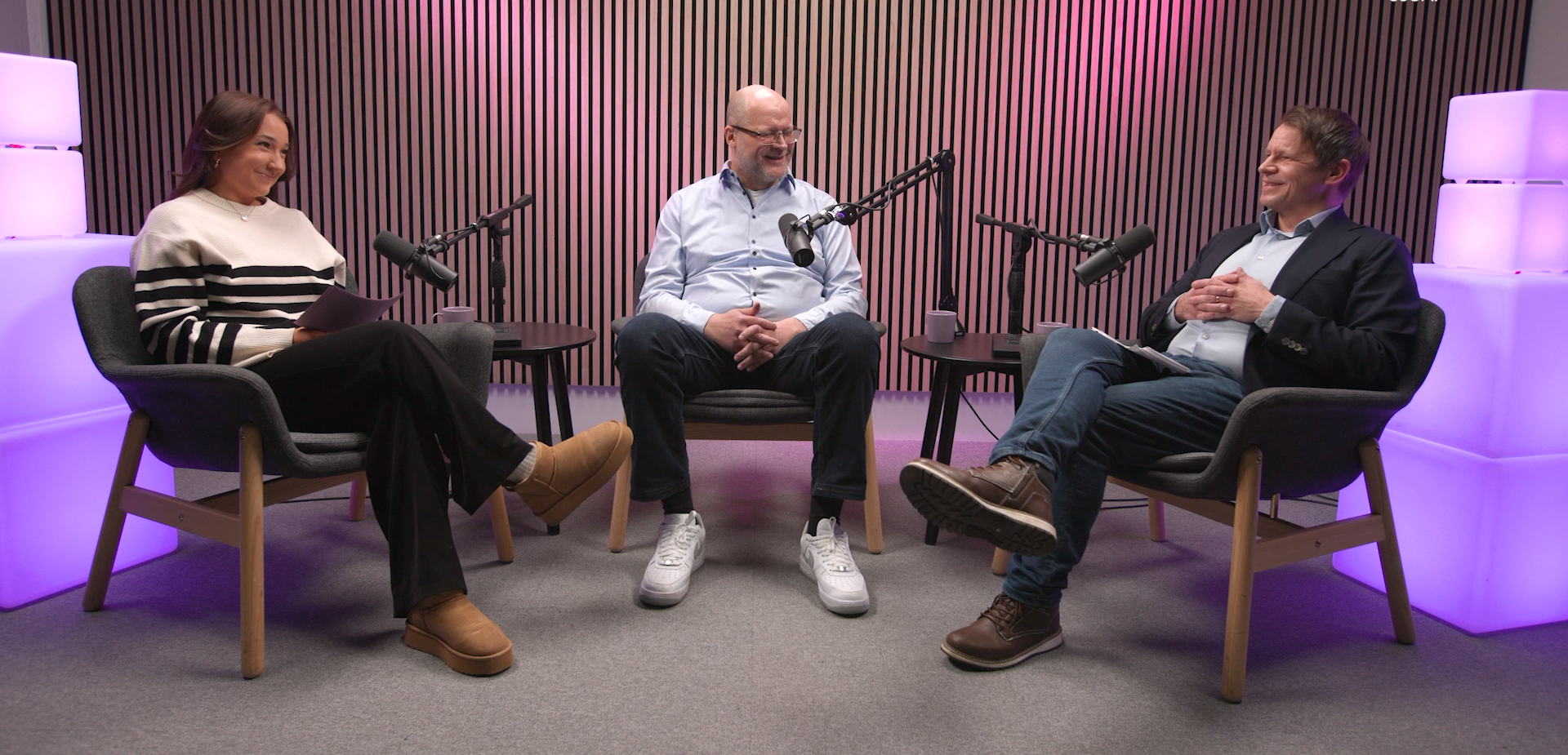
At Softability’s R&D Tech Talk Suomi podcast, this topic was explored together with ABB’s Marine & Ports division Corporate Executive Engineer Kalevi Tervo, Softability CEO Janne Repo, and our host, Softability Key Account Manager Katariina Sorkkila. Their discussion highlights that technology leadership is not about chasing trends—it’s about courage, long-term thinking, and the ability to connect vision with execution.
Technology leadership starts with courage
Technology leadership begins with mindset. It requires the willingness to look beyond incremental improvements and aim for something significantly more ambitious.
As Kalevi Tervo puts it in the episode, “you have to have the courage to think big—truly aim for something radically new.”
But ambition alone is not enough, focus is equally critical. Even the most capable organizations cannot excel in everything, which makes prioritization a strategic necessity.
At Softability, we see this balance between bold ambition and deliberate focus consistently in successful R&D organizations. The ones that truly lead are those that dare to differentiate – and are disciplined enough to commit to it.
This theme is also explored from ABB’s perspective in their
article on technology leadership, where the roles of courage and long-term thinking are highlighted.
Understanding what customers truly need
A critical element of technology leadership is the ability to understand customers on a deeper level. It is not enough to respond to current requests or surface-level needs. Instead, organizations must anticipate what will create real value in the future.
This idea was strongly emphasized also in Kalevi’s and Janne’s discussion: understanding what customers truly need is not the same as simply delivering what they ask for.
That connection becomes especially meaningful when solutions are put into practice. As Janne describes it, “the real fulfillment comes when you see that what you’ve built is actually being used and creating value.”
This is where engineering work transforms into something bigger – something impactful.
Long-term vision, step-by-step execution
Building a sustainable technological advantage is not a single leap – it is a journey that unfolds over time.
It requires the ability to look far ahead while still making steady progress in the present. As Kalevi notes, “you need to look far ahead, but execute step by step.”
In practice, this means accepting uncertainty. The further into the future you plan, the less precise your assumptions can be. Rather than trying to eliminate that uncertainty, successful organizations build flexibility into their strategies and evolve them over time.
Working with a wide range of R&D clients, we’ve seen time and again that the most effective R&D strategies are not rigid plans but living frameworks—guided by a clear vision yet adaptable as technologies and markets shift.
Balancing short-term delivery and long-term innovation
One of the most challenging aspects of technology leadership is balancing immediate business needs with long-term innovation. Organizations must deliver value today while investing in capabilities that may only pay off years later.
This balance is not static—it needs to evolve as conditions change. But what remains constant is the importance of connecting daily work to a larger purpose.
When that connection is clear, it changes how teams approach their work. Janne captures this shift well when describing how understanding the bigger picture transforms even routine tasks into something more meaningful.
Rethinking failure: From risk to opportunity
Innovation always involves uncertainty, and with uncertainty comes the possibility of failure.
One of the most important mindset shifts discussed in the podcast is how organizations relate to failure. Kalevi puts it succinctly: “failure itself is not dangerous—but fear of failure is dangerous.”
When fear starts to guide decision-making, organizations tend to play it safe, thereby limiting their potential.
At the same time, failure can lead to unexpected outcomes. Sometimes, the original goal may not be achieved, but something valuable emerges along the way. This ability to “fall forward” is a key part of innovative environments.
The role of teams and talent
Technology leadership is ultimately built by people. Even the strongest strategy depends on the team’s ability to execute it.
High-performing teams are rarely uniform. Instead, they combine different perspectives, experience levels, and ways of thinking. This diversity is not just beneficial—it is essential for innovation.
At Softability, we emphasize building teams that are both technically strong and collaborative. Leadership plays a key role in creating an environment where ideas can be challenged constructively, and decisions can be made effectively.
Global collaboration adds another dimension. While distributed teams can introduce complexity, they also create opportunities—enabling continuous progress and access to a broader talent pool.
Final thoughts: Dare to aim high
If there is one message that stands out in the conversation, it is the importance of courage when building strong technology leadership.
As Janne puts it, “we need courage—courage, courage, courage.”
Building a technological advantage requires the willingness to aim high, even when the path forward is uncertain. It requires persistence, long-term commitment, and the ability to move forward despite risks.
Because in the end, striving to be the best is never easy. In Kalevi’s words:
“If it were easy to be the best in the world, every company would surely be the best.”
Softability’s R&D Tech Talk Suomi podcast brings together insightful technology and R&D leaders to discuss real-world challenges and share insights across industries.